Crockett Council Advances Business Development Talks; Hicks Votes No
By Greg Ritchie
Messenger Reporter
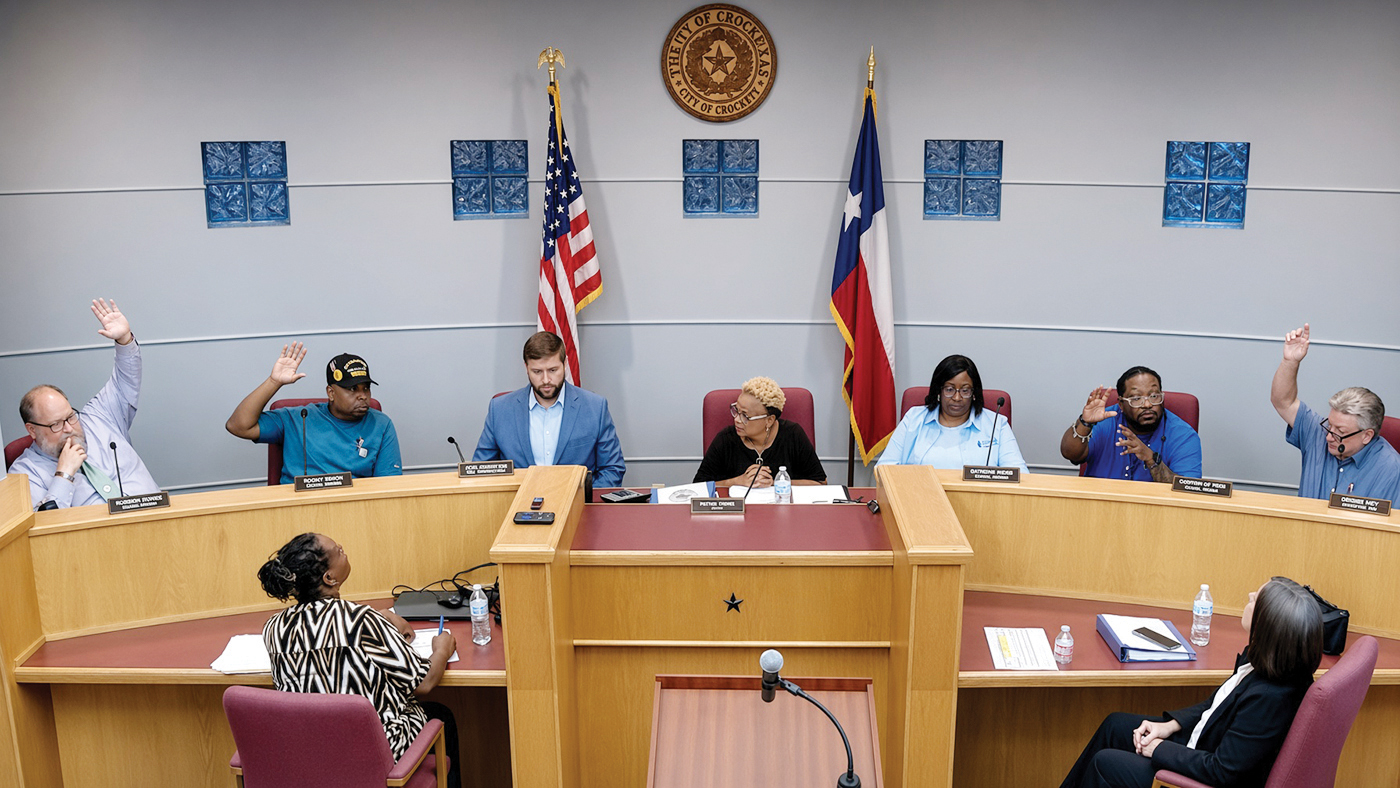
CROCKETT — A sharp disagreement over the wording of council minutes, a lone dissent on proposed tax-abatement negotiations and a planned public explanation of the city’s license plate readers highlighted the Crockett City Council’s meeting Monday, September 21.
The council also received its regular police and fire reports, reviewed a substantially rewritten Crockett Police Department policy manual and tabled an emergency wastewater repair resolution until more cost information is available.
The meeting opened with a dispute over the wording of minutes describing a statement Council Member NaTrenia Hicks read at an earlier meeting.
The discussion about minutes revolved around a proposed correction to language describing Hicks’ statement from a previous meeting. The original wording said Hicks disagreed with the current city government structure. The proposed correction, requested by Hicks, would instead describe Hicks as agreeing with opposition to a city-manager structure and concerns about a lack of oversight.
The council also spent considerable time discussing how much detail should be included in meeting minutes and how proposed corrections should be handled.
City Administrator John Angerstein emphasized the importance of reviewing minutes before the meeting.
“I’d really like to stress how important it is that we have a week of review process,” Angerstein said. “We can definitely circle in attorneys. We can circle in whatever is required to have proper minutes presented instead of this last-minute throwing of curveballs that really does not address what minutes are for.”
Angerstein said corrections should be raised during the review period, allowing council members to prepare statements and determine whether the minutes were incomplete or inaccurate.
He also explained that the minutes were intended to summarize the meeting rather than reproduce every statement made.
“Minutes are not meant to provide a detailed recount because things will be missed,” Angerstein said. “It’s an overview or a summary of what happened.”
The discussion continued over whether Hicks’ proposed correction represented an appropriate clarification or an attempt to change the record after the fact. At one point, Angerstein called the timing of the change “a blind side”.
Hicks asked whether minutes could be corrected at any time or whether there was a specific deadline for making corrections. She said the wording in the minutes did not accurately reflect what she intended to say.
“When I read the minutes, it clearly seemed like somebody took my intent differently,” Hicks said. “So, I’m giving you what my intentions were. I want to make sure that nobody’s taking and re-creating my wording of what my intent is.”
Mayor Dr. Ianthia Fisher suggested that providing a written copy of Hicks’ statement would make the council’s review easier and help ensure the wording was accurate.
Hicks agreed to submit a copy.
“I’ll submit a copy of this and make sure that it’s in the minutes,” Hicks said.
The council ultimately approved the minutes with the proposed corrections.
During the regular reports, Police Chief Clayton Smith presented the Crockett Police Department’s August manpower and criminal-incident figures.
The department had 16 officers who worked a combined 2,785 hours during the month. Officers responded to 435 calls for service, investigated six traffic accidents, made 36 arrests and issued 297 citations. The department also completed 62 reports and responded to 28 alarm calls, 24 of which were false alarms.
Smith also presented an extensively revised department policy manual. He said the previous manual had accumulated policies over the years, resulting in outdated, redundant and conflicting material.
“Our policy was extremely outdated,” Smith said.
The new 355-page manual was prepared using current legal and constitutional standards as well as Texas Best Practices. Smith said the policies had been tailored specifically to the Crockett department.
“What we’ve done is make sure it was tailored to our department,” Smith said.
Smith asked council members to review the manual and send him specific questions. He said he hoped to bring it back for consideration at the next meeting or in October.
Smith also asked council to place an item on a future agenda to discuss the city’s license plate readers. He said he had received phone calls, emails and questions from members of the public about the technology and wanted to explain how the system works and how it benefits the department and community.
“For the record, we do not have Flock,” Smith said.
Smith said the city’s system is similar to Flock but is not the Flock system. The council approved placing the presentation on a future agenda.
Fire Chief Jason Frizzell reported 32 calls during August. Eighteen calls were within the city, while 14 were in the department’s county response area.
The council also approved a bid for repairs to the fire station bay floor using American Rescue Plan Act funds. Questions were raised about the timing of the bid presentation and documentation concerning the use of the federal funds, but the motion ultimately passed.
A separate item involving the Southside Wastewater Treatment Plant was tabled.
The agenda called for the council to consider declaring an emergency condition caused by the failure and damage of a secondary clarifier and to authorize immediate repairs without the normal competitive procurement process.
The clarifier has been out of operation for several months, and the age of the equipment could affect the availability and cost of replacement parts.
Rather than approve the emergency repair resolution without those figures, the council voted to table the matter until cost estimates and funding details are available.
After entering executive session to discuss economic-development negotiations with a business prospect, the council reconvened in regular session to consider action.
Council members approved moving forward with negotiations with Circle T Feed on a proposed 10-year tax-abatement agreement. The proposal would provide a 100% abatement for the first five years, followed by a phased reduction during years six through 10.
Hicks was the only council member to vote against moving forward with the negotiations.
The vote authorized the city to continue discussions with Circle T Feed. It did not represent final approval of a completed tax-abatement agreement.
The meeting ended after the council approved placing the license plate-reader presentation on a future agenda and adjourned.
Greg Ritchie can be reached at [email protected]