Groundwater Project Volumes “Terrifying”

Greg Ritchie
Messenger Reporter
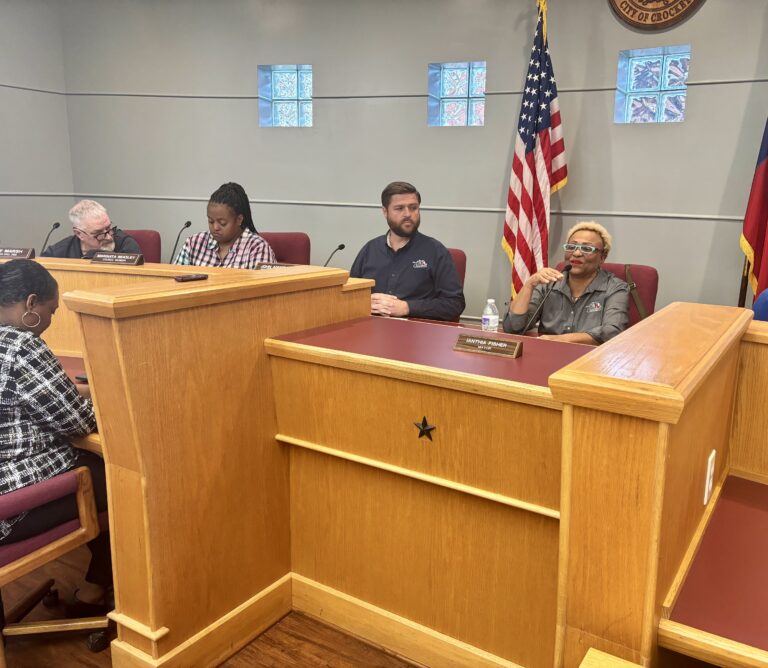
HOUSTON COUNTY – The Messenger concludes its two-part series covering the testimony from representatives in Houston County during the Committee on Natural Resources testimony in Austin, Tuesday, July 15.
Ben Matthews, attorney for Matthews and Freeland L.P., an Austin-based law firm focusing on environmental issues, particularly those related to water and air quality, as well as water rights and water utility issues. Matthews came to speak on behalf of the City of Crockett and Houston County Water Control and Improvement District Number One.
“These are not large corporations. These are small, local systems that have been built over generations to serve their communities. They’ve invested in wells, pipes, and pumps to deliver water reliably and affordably to the people who live there,” Matthews said. “But today, the ability to serve may be in jeopardy. When massive amounts of groundwater are pumped from the ground and sent miles away, aquifer levels can drop fast. That drop doesn’t stop at the fence line, or the county line, or even the boundary of a groundwater conservation district. It affects every well around it. And when that happens, my clients are the ones who pay the price—for broken pumps, failing motors, deeper drilling, or entirely new wells.”
Matthews called out Bass’ companies, using the language found on their own website as fodder.
“The applicant presents itself as solving a statewide water problem—moving water from where it exists in abundance to places where, in their words, it is ‘most needed.’ But make no mistake: this is a private, for-profit groundwater export operation. The PR is polished, but it doesn’t change the core facts. Their models claim there won’t be meaningful drawdown, but models are built on assumptions, and assumptions can be wrong. We’ve all seen that happen,” Matthews said. “They plan to drill exploratory test wells, but test well data isn’t the same as 20 years of continuous, high-volume pumping. There is no guarantee that the aquifer will respond the way they predict once large-scale withdrawal begins.”
Hunstville-based Ron Hudson, Director of Facilities Division of Texas Department of Criminal Justice told lawmakers the issues their facilities could face if the projects move forward.
“This agency operates 12 prisons in East Texas, where over 23,000 individuals are incarcerated and over 4,700 East Texas residents work. These prison units also manage agricultural, livestock, and crop operations, which offsets the state’s appropriations to the agency by $59.6 million. TDCJ operates several manufacturing operations within these presence of goods and services to support key state functions. Given the proposal for high capacity and large volume groundwater production in the Neches and Trinity Valleys Groundwater Conservation District, this means units in Houston, Rusk, Freestone, and Madison Counties may see as direct water supply impacted,” Hudson told lawmakers. “There are seven TDCJ prison units depending on water directly from the NTVGCD. In addition to these seven units, there are five East Texas prison units depending on water from the Carrizo-Wilcox aquifer. In total, these 12 Texas prison units depend on water for consumption, agricultural, and domestic uses to operate and maintain public safety.”
Ashby noted TDCJ plays a significant role in East Texas: “When new well have to be dug, who pays for that?”
“The taxpayers.”
Houston County Commissioner Gene Stokes told the committee these permits should be denied, period.
“Houston County is opposed to the permits to drilling and remove alarming, massive quantities of water through 21 wells in Anderson County and another 11 wells in Houston County. I think we’ve all decided it’s an alarming amount of water to be exported from underneath us,” Stokes told lawmakers. “The public interest of East Texans are water security and economic development. When the water level drops, economic activity in East Texas is stopped. Our community spent a lot of money on water — drilling wells for public water, and this threatens that. This threatens a big investment made by Houston County and the residents there to secure water into the future. I would ask you to consider doing everything in your power to, at the bare minimum, postpone these permits.”
Stokes went on to note groundwater districts need more teeth, telling lawmakers the system is broken and, “not designed for what’s being asked of it.” He admitted residents of Houston County were skeptical of establishing a groundwater district in 2011, something they would now support, given recent events.
Consolidated Water General Manager Amber Stelly brought cold, hard facts to the committee, noting her organization are affected parties in the groundwater dispute. She is also the newly-appointed Vice-Chair of a committee headed by Dr. John McCall to establish a groundwater district in Houston County.
“When we look at the applicant’s hydrology studies, it’s 61,800 acre feet from the Carissa Wilcox aquifer. I had trouble understanding that number. It’s 20.1 billion gallons. It’s 10 counties worth of water: Anderson. Houston, Walker, Angelina, Cherokee, Freestone, Henderson, Leon, Navarro, and Trinity Counties. Their combined 2022 use was less than the 61,000 acre feet that is proposed in the project documents,” Stelly told wide-eyed lawmakers. “According to the applicant’s own hydrology reports, this is an export project. Redtown Ranch is in Region I, that’s where my 12 wells are for my system. Region I is already experiencing an issue. They have shortages. Region I is also projected to have a shortage of about 183,000 acre feet by 2030, 205,000 acre feet by 2070. That number is more than some of the needs that are cited in the applicant’s report for these other areas.”
Stelly said the volumes mentioned in the application are so vast, their models struggled to cope with them properly.
“That’s a terrifying amount of volume. What I’m most concerned about, when I look at those numbers, is, of course, my own members. I mentioned 16,800 members, and people — voters,” Stelly clarified to the elected representatives. But then there are the thousands that I don’t serve right now, and I don’t know what that number is. Right now, those residents have a private well, they don’t want my water, and I don’t want them to be forced to buy my water if their wells dry up. Our private well owners are very good stewards of the environment. They can do a lot with a very small amount of water. However, if these commercial wells go online, there will be private well failures that will be almost immediate.
Stelly testified the sudden crash of private wells could lead to even more devastating consequences.
“We will be faced with the pressure and the public health emergency of how do we get these people water? They’re going to need water and they’re going to need it fast. Some of our local well drillers, they might already be two years out. So, we’re going to be faced with, I’m going to say, unprecedented service emergency here. I don’t have a solution right now, but I am inspired to see how many people are in this room that care. I’m really pleased. I think that with everyone I’m looking at right now, we actually have the people we need to solve this problem. We need a modernization of rule of capture problem and I want to work with everyone in here to do that.”
Stelly concluded with some questions of her own, pointing out that water figures are always just accepted to fall, without planning to increase them over time.
“I’ve heard a lot of talk about ‘desired future condition.’ I did some research there. I didn’t hear anyone mention a desired future condition that was more water than we have now. It’s always less water than we have now. It’s always, ‘What are we willing to accept? What is the loss of the aquifer that we’re okay with? And I think that that is a bad way of thinking.”
The measure will go to a state SOAH (State Office of Administrative Hearings) session later this year. The hearing will receive testimony and evidence from both sides. The companies wishing to drill the wells requested this hearing and will bear all the costs of it. The SOAH findings are not necessarily binding on the groundwater district, who does have the ability to reject the recommendations from the state, under certain circumstances.
A recently-filed lawsuit may trump all of the political and legal maneuvering, however. See related story in today’s edition.
Greg Ritchie can be reached at [email protected]