
Calendar Pairs Crockett’s Past With Its Present
By Greg Ritchie
Messenger Reporter
CROCKETT — A movie marquee, a line outside a bank and the view from a courthouse tower can tell quite a story — if someone takes the time to look closely.
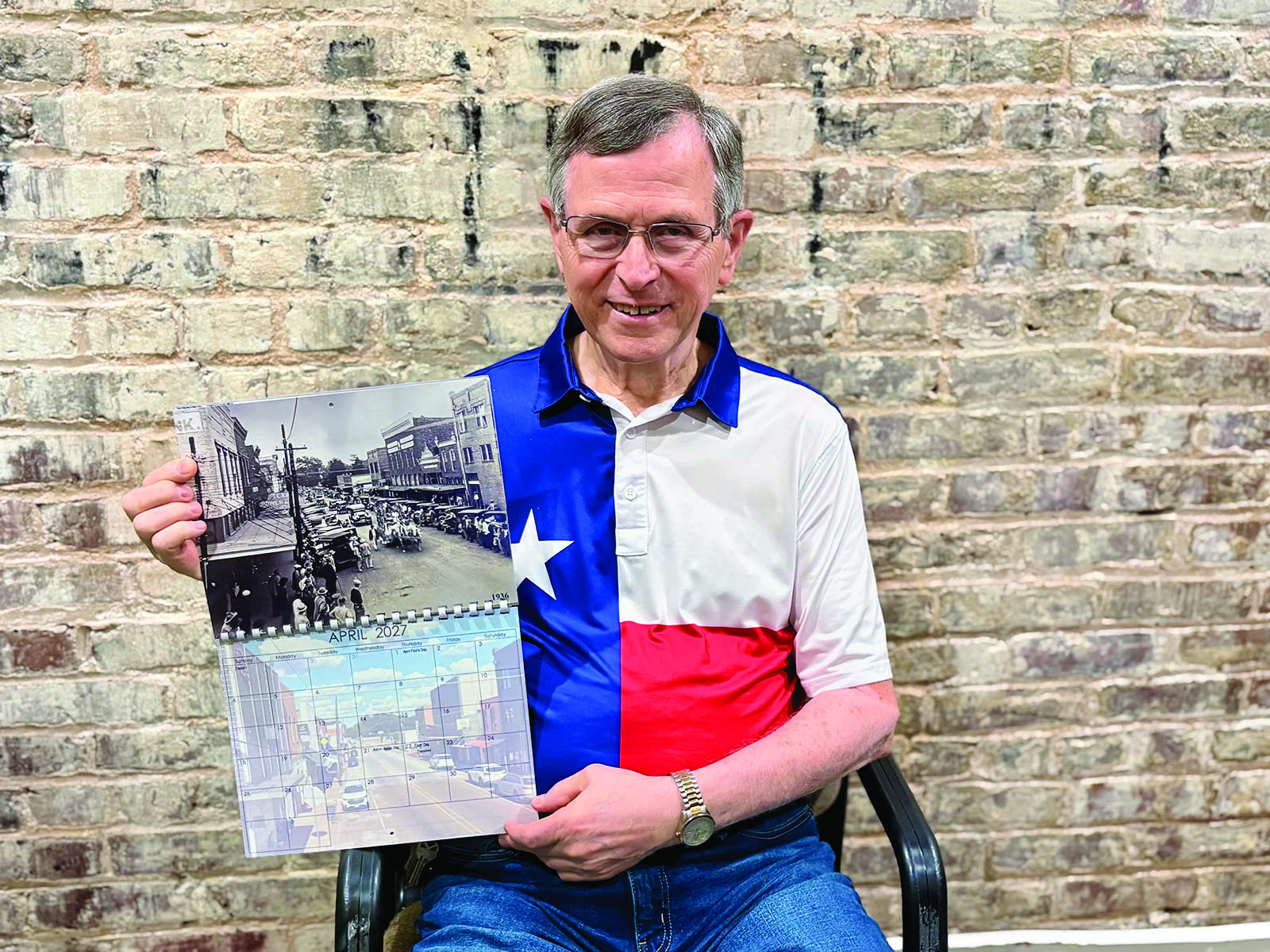
For a group of local history enthusiasts, those details have become clues in an effort to document downtown Crockett’s past. Now, some of the photographs they have collected are finding their way into homes through a new calendar that pairs historic scenes with present-day views from the same locations.
Dr. John Garner said the project grew out of a larger undertaking: researching the businesses that have occupied downtown buildings, address by address, and preserving that information in a book.
Along the way, the group found photographs worth sharing before the book was finished.
“We wanted to show the community, and everybody around there, we’re serious about this,” Garner said. “We want to show that there is a lot of history to be preserved, to be proud of, to take advantage of.”
The calendar is available for a $20 donation, with proceeds helping finance publication of the downtown history book. Proceeds from the book would then help fund a Davy Crockett statue in Crockett.
Sales began Sunday, Oct. 11. The calendar starts with November of this year and looks ahead to 2027, when Crockett and Houston County will mark their 190th anniversaries.
For Garner and the other volunteers, the project is about preserving information that can disappear as people who remember earlier businesses and buildings are lost.
He described the preservation group as a loose collection of friends interested in chronicling local history. While other books have documented families, churches and communities, the group saw a need to record the changing occupants of downtown storefronts.
Their planned book will cover a 24-block downtown area, tracing its business history as far back as the city’s beginnings in 1837.
That has meant searching old telephone directories, newspaper pages and advertisements in school yearbooks. Each can help establish where a business operated and when it was there.
An earlier appeal for telephone books brought help from the public. Garner said the group also acquired a 1938 Crockett directory through the internet from an out-of-state source, finding it in remarkably good condition.
The search continues.
“We would still appreciate any phone books before 1950,” he said.
Photographs preserved by Charles Arnold, David Tyre, Mike Molnes and the late Butch Hallmark helped provide another way to explore the downtown district.
The calendar includes historic images dating back to 1884, Garner said. Matching them with modern photographs allows readers to compare familiar buildings and streets with scenes recorded generations earlier.
“It gives a perspective of things and appreciation for what’s happened in the years between,” he said.
Preparing those comparisons involved more than finding an old photograph and taking a new one nearby. The group worked to reproduce the original vantage points so readers could follow the buildings and streets from one image to the next.
Garner said artificial intelligence was used to help clean up the historic images. New photographs were then taken from corresponding angles.
Some of those angles proved difficult to reach.
The old courthouse tower was gone. So was a water tower that had provided another elevated view. Garner said an attempt to photograph from the current courthouse still did not provide enough height.
Brandon Quillin Houston County Electric Cooperative helped by taking drone photographs of scenes the group could not otherwise reproduce.
The resulting comparisons reward a closer look. A building may have changed uses, lost an upper story or acquired a different storefront, while neighboring structures remain recognizable.
Garner said readers should not feel they have to take in every detail at once.
“You’ve got a whole month to look at it,” he said. “You can keep looking at it and see more information as time goes on.”
Dating the historic photographs became a research project of its own.
One image showed the former Auditorium Theater, at the location later occupied by the Ritz Theater. To narrow down the date, the group examined the movie marquee and identified a Tom Mix cowboy film.
Garner said researching the film’s release led them to date the scene to 1926. The automobiles visible in the photograph provided additional clues.
Another image showed the old First National Bank building, which had offices upstairs. The group initially dated the photograph to about 1929, using the surrounding businesses and other details to narrow the possibilities.
After the calendar was printed, Garner said a closer examination drew attention to something else: people lined up outside the bank while much of the surrounding sidewalk appeared empty.
He believes the scene captured a bank run in the fall of 1929, a conclusion the group reached while studying the photograph’s details.
The calendar also features the county’s previous courthouse, an ornate building that was demolished to make room for its replacement, the current courthouse.
For Garner, the images offer an opportunity to consider both what Crockett has retained and what it has lost. They also give younger residents a view of places their parents and grandparents may have described.
Producing the finished calendars required another kind of teamwork.
The printed materials arrived in boxes, leaving volunteers to assemble the calendars themselves. They punched holes, installed the binding and added the hanging holes, keeping production costs down through their own labor.
Garner said the work took on the rhythm of an assembly line.
“We actually mentioned Henry Ford’s name several times on that assembly line,” he said.
The calendars have also drawn interest as gifts for people who grew up in Crockett and moved away. Garner said buyers have welcomed the chance to send family members something tied specifically to their hometown — photographs they can continue to enjoy after the calendar year ends.
Calendars are available at Moosehead Cafe, Davy Crockett Drug, Knox Furniture and Crockett Bank, as well as through members of the preservation group. The requested donation is $20, payable by cash or check.
For more information about the calendar or to help with the group’s historical research, contact Garner at 936-222-3183.
Greg Ritchie can be reached at [email protected]


