Groundwater District Proposal Moves Into Next Stage
By Greg Ritchie
Messenger Reporter
HOUSTON COUNTY – What began last year as an effort to give Houston County more control over its groundwater has now moved from committee meetings and courthouse discussions into the formal state process that could eventually put the question before county voters.
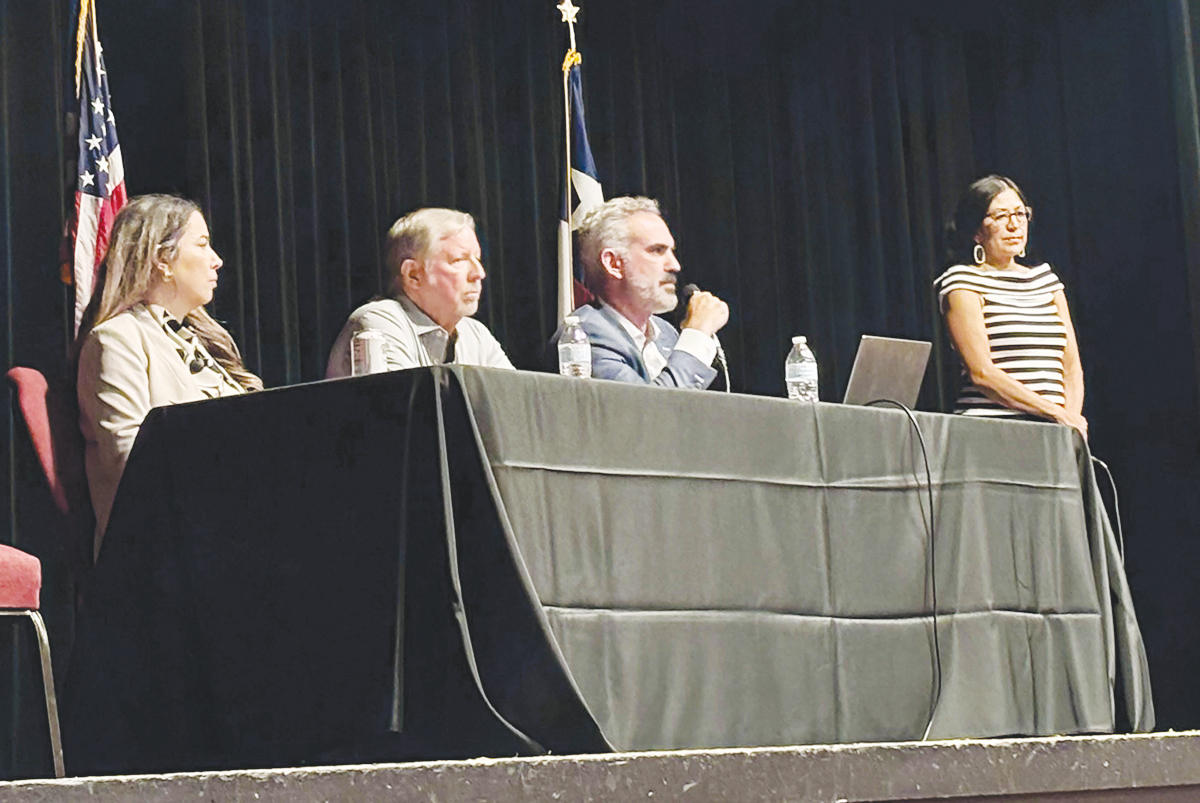
The Texas Commission on Environmental Quality (TCEQ) held a public meeting Tuesday, Sept. 29, at the Crockett Civic Center concerning a landowner petition seeking creation of the Houston County Groundwater Conservation District.
The meeting did not create the district, nor did it represent the final decision on whether one will exist. Instead, it offered residents an opportunity to ask questions and submit formal comments as TCEQ considers whether to certify the petition and appoint temporary directors. TCEQ’s executive director will summarize comments from the meeting before making recommendations to the commission.
For Houston County, however, the issue began long before Tuesday night.
Interest in creating a local groundwater district accelerated in 2025 amid concern over plans connected to businessman Kyle Bass and Conservation Equity Management to explore large-scale groundwater production from the Carrizo-Wilcox Aquifer in East Texas.
Bass has maintained that exploratory wells are intended to determine what the aquifer can sustainably provide before any large-scale production decision is made. The broader proposal, if testing supported the company’s models, contemplated pumping approximately 48,972 acre-feet, or about 15.9 billion gallons, annually from the aquifer.
Houston County drew particular attention because it did not have a groundwater conservation district regulating large-volume pumping. During a 2025 legislative hearing, state Rep. Trent Ashby said Redtown Ranch plans included 15 high-capacity wells in Houston County and warned that the absence of a local district left the county without the same groundwater regulatory structure found in neighboring areas.
That concern helped push Houston County officials toward reconsidering an idea that had surfaced locally before: forming a groundwater conservation district of its own.
In June 2025, Houston County commissioners began discussing how such a district might be developed and emphasized the importance of local planning, governance and funding. On June 30, commissioners appointed Barrett Riess, Randy Parten, Dr. John A. McCall, Amber Stelly and Jimmy Gaines to a Ground Water Conservation District Development Committee and expanded the county’s legal representation to assist with development of the proposal.
Since then, the proposal has moved from a county committee into a landowner petition governed by state law.
More than 50 Houston County landowners signed the petition requesting creation of a district whose boundaries would follow the boundaries of Houston County. The petition was formally submitted to TCEQ on March 5.
Tuesday’s meeting showed that as the proposal has become more concrete, so have the questions surrounding it.
Discussion covered the practical consequences of creating a district, including how it would be funded, what authority it could exercise, how private wells could be affected and how much control would remain with Houston County residents.
Discussion repeatedly returned to local control, reflecting one of the ideas behind the effort from its beginning. A groundwater conservation district is a locally governed political subdivision created to manage groundwater resources within its boundaries, although it operates within powers and responsibilities established by state law.
But local control would come with a cost.
The proposed district budget totals $505,235 annually. Of that amount, $489,825, or 96.9%, is projected to come from property taxes under a proposed tax rate of $0.019 per $100 of taxable value.
At that rate, a property with $100,000 in taxable value would generate $19 per year for the district.
The remaining projected revenue would include $9,101 in groundwater production fees, $3,909 in export fees and $2,400 in permit fees.
Among the larger proposed expenditures are $168,000 for payroll and payroll taxes for a general manager and office manager, $73,000 in legal fees, $52,000 for professional consulting, $48,000 for an automobile, $32,000 in employee benefits and $25,200 in rent.
Those figures became particularly relevant as discussion Tuesday turned from the idea of protecting groundwater to what operating a permanent district would actually require.
Questions also focused on private wells and property rights.
That issue remains one of the areas readers should distinguish carefully from the larger concern over industrial-scale groundwater production. Creating a groundwater conservation district would not mean every well in Houston County would automatically be treated the same as a high-capacity commercial well.
At the same time, the complete rules of a future Houston County district have not yet been written.
Discussion at Tuesday’s meeting addressed domestic wells, agricultural use, groundwater pumping and the extent of authority a future district could exercise. Exactly how particular wells might be registered, exempted, permitted or otherwise handled would depend on state law and rules ultimately adopted by the district if voters approve its creation.
The proposal therefore remains unfinished in an important sense. The petition establishes the district’s proposed structure and finances, but a future board would still have significant work ahead in developing the detailed rules governing groundwater use.
The petition also identifies five people proposed to serve as temporary directors if TCEQ certifies the petition: Kenneth Dewayne High for Precinct 1, Randy Parten for Precinct 2, Craig Broxson for Precinct 3, Darrel Bobbitt for Precinct 4 and Charles “Chuck” Cunningham for Precinct 5.
Those proposed temporary directors are separate from the original county committee that helped develop the groundwater district proposal. McCall, who chaired the earlier committee during much of the planning process, is not among the five temporary directors named in the petition.
Even appointment of those directors would not mean the district had received its final approval.
Under the Texas Water Code, if TCEQ certifies the petition, the commission appoints the temporary directors named in it. Once all temporary directors have qualified, they have no more than 120 days to order an election asking voters whether the district should be created and electing permanent directors.
Because the Houston County proposal includes a maintenance tax, state law also requires a separate proposition concerning that tax. If voters reject creation of the district, the district does not proceed. If voters approve creation but reject the maintenance tax, state law provides for the district to fund groundwater regulation through authorized fees instead.
That means Houston County residents are not yet being presented with a finished groundwater district, but the framework for one.
The effort began with concern that large-volume groundwater development could move forward in a county without its own groundwater conservation district. Tuesday night’s discussion showed the other side of that decision beginning to come into focus: what authority Houston County residents are willing to give a new local government entity, what they are willing to pay for it and what protections they expect in return.
For now, the next decision rests with TCEQ.
If the petition is certified, the larger decision will eventually belong to Houston County voters.
Greg Ritchie can be reached at [email protected]