Rocky Springs Cemetery Receives Historic Texas Cemetery Designation
By Greg Ritchie
Messenger Reporter
GRAPELAND — When Dr. Joe Coleman first began searching for Rocky Springs Cemetery, he was looking for a place connected to his own family.
An aunt had told him that several relatives were buried there, including his great-grandmother and great-grandfather. Coleman, a Grapeland native and 1986 Grapeland High School graduate, knew very little about the cemetery’s location or history.
Two and a half years later, his search has helped bring formal recognition to the small cemetery west of Grapeland and to the community that once surrounded it.
In a July 31 letter, the Texas Historical Commission notified Coleman that Rocky Springs Cemetery had been designated a Historic Texas Cemetery. The commission described the designation as an important first step toward protecting and preserving the site. It also noted that the designation makes the cemetery eligible to be considered for an Official Texas Historical Marker.
“I thought, well, this probably needs to be a cemetery that gets some recognition for its age and maybe for some of the things that people did in that community,” Coleman said.
Coleman’s interest in the cemetery grew from both family ties and his background in history. He earned a history degree from the University of Texas at Tyler, later received a master’s degree from Prairie View A&M University and completed a doctorate at Baylor University. He spent roughly 30 years working in education administration and continues to support principals across Texas.
But finding Rocky Springs Cemetery was not simple.
The cemetery is located in the Rockhill area west of Grapeland, on private property. Coleman said he first had to speak with longtime residents and relatives, examine property information and work through the clues that remained.
“When somebody’s telling you kind of where it was, and you go look and it’s a bunch of weeds and bushes, it’s still hard to find,” Coleman said.
Once he located the cemetery, Coleman began documenting the graves and researching the people who had been buried there. His work has included property records, obituaries, cemetery records and conversations with descendants and older residents familiar with the area. He has conducted approximately 40 interviews connected to Rocky Springs Cemetery and the surrounding community.
The cemetery contains an estimated 70 graves, according to Find a Grave records. The oldest documented grave Coleman located is that of William Doby, who was born in 1863 and died in 1915. That places the cemetery’s documented history at least 111 years.
Coleman believes some graves may be older, but he said many of the cemetery’s burial sites are marked only by rocks or have no visible marker at all. Because those graves cannot be verified through formal records, he has been careful not to assign dates that cannot be documented.
Two veterans are also buried at Rocky Springs Cemetery: Pvt. Fred Washington, associated with World War I, and Pfc. Butler Lewis, associated with World War II.
The cemetery is a reminder that Rocky Springs was once more than a burial ground. Coleman’s research indicates that a Black community developed in the area around a church, school and cemetery.
Historical records and family interviews suggest that Rocky Springs Baptist Church was active by the late 19th century and may have been part of a broader rural community established during or shortly after Reconstruction. Coleman said he cannot definitively classify Rocky Springs as a freedom colony, but the community shared many characteristics associated with those settlements.
Freedom colonies were rural Black communities formed after the Civil War, often organized around churches, schools, farms and cemeteries. In many cases, the church served as both a place of worship and a schoolhouse, while the cemetery became one of the few lasting physical records of the community.
According to interviews Coleman conducted with relatives and longtime residents, Rocky Springs included sharecroppers, a community baseball team and a gospel group known as the Rocky Springs Gospel Singers. Residents worshipped and fellowshipped with nearby churches, and baptisms were held at Little Elkhart Creek.
The community’s baseball teams competed against other teams in the area, including teams as far away as Palestine. Those games took place during segregation, when Black communities often formed their own athletic, religious and social networks.
Obituaries have also helped Coleman establish the community’s history. The obituary of Belle Gipson, who lived from 1881 to 1982, states that she joined Rocky Springs Baptist Church at an early age. The obituary of Coleman’s great-grandmother, Mary Bell White, states that she joined the church under the leadership of Rev. I.P. Hunt.
For Coleman, those records help connect individual lives to the larger story of Rocky Springs.
“There’s a lot of local history out there in Grapeland that we just were not exposed to,” Coleman said.
The physical work of caring for the cemetery has been another part of the project. Coleman said the site had become overgrown, and keeping it clear will require continued attention.
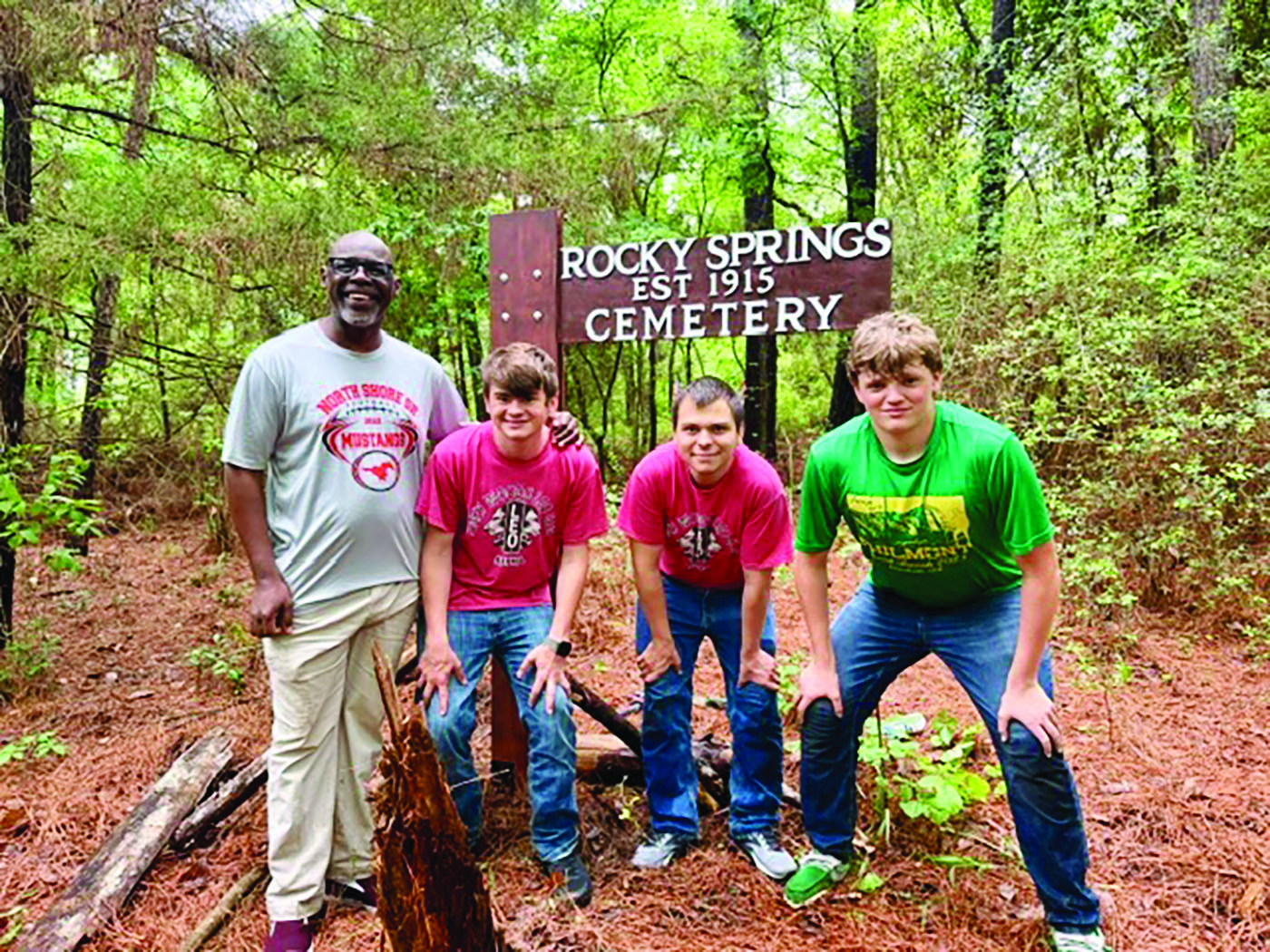
Two young men working on Eagle Scout projects, along with their families and other volunteers, helped Coleman clear brush and identify features around the cemetery. Volunteers placed pink flags and white crosses near some possible graves, helped measure the cemetery and created a map of the property. A flag was also placed near the grave of one of the veterans.
Coleman said he hopes to establish a committee that can help arrange regular maintenance, possibly including cleanups in the fall and spring.
The Texas Historical Commission’s designation does not make Rocky Springs Cemetery a public park or automatically open the private property to visitors. Coleman said he has tried to coordinate his visits with the property owner and does not want to create problems by organizing a large gathering without permission.
“I try to be respectful to the owner there,” Coleman said.
Anyone seeking to visit the cemetery should first obtain permission from the property owner. Coleman said the site deserves recognition, but that recognition must be balanced with respect for the land and the people who own it. Those interested in visiting should contact Coleman directly.
The Historic Texas Cemetery designation gives Rocky Springs a permanent place in the state’s official record. It also provides a foundation for future preservation work, including the possibility of applying for an Official Texas Historical Marker.
For Coleman, however, the importance of the designation is found in the people whose lives were connected to Rocky Springs Baptist Church, the school, the surrounding farms and the cemetery on the hill.
“It was a lot of learning for me,” Coleman said. “I got the opportunity to learn a lot about places in my hometown and places in Houston County.”
Coleman may be contacted at [email protected] by anyone with information, family history or records connected to Rocky Springs Cemetery and the former Rocky Springs community.
Greg Ritchie can be reached at [email protected]