A Sword, a Mule and a Mystery
Civil War Relic Resurfaces in Houston County
By Greg Ritchie
Messenger Reporter
HOUSTON COUNTY – Inside the Houston County annex building in downtown Crockett, history briefly became a hands-on experience.
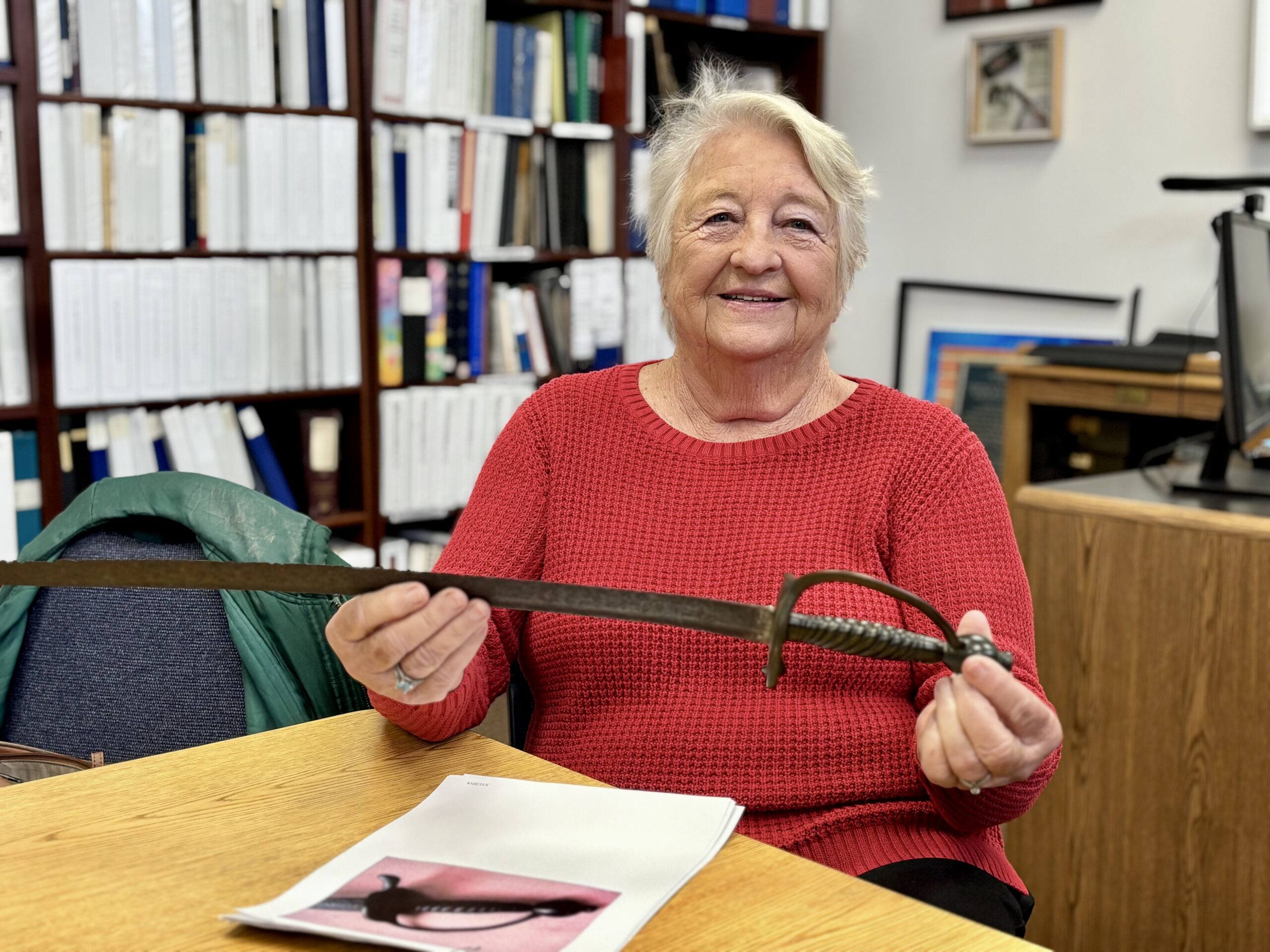
As members of the Houston County Historical Commission prepared for their regular meeting, visitors drifted through the office, pausing to ask questions, lean in closer and marvel at a heavily rusted sword laid carefully across a table. Some snapped photos. Others simply stared, imagining the long journey that brought the blade there.
The sword, believed to date to the Civil War era, was unearthed not recently, but more than a century ago — sometime around 1921 or 1922 — when two brothers, Calvin and Bailey Duitch, struck metal while plowing a field behind a mule near Grapeland.
“They dug it up with a hand plow,” said commission director Wanda Jordan. “This wasn’t last week. This was a hundred years ago.”
Rather than tossing the corroded blade aside, the brothers took it home and held onto it for decades. In the mid-1950s, the family even sent the sword away to be authenticated, curious whether it might be older than the Civil War. The verdict came back clear: the sword was U.S.-made and dated firmly to the Civil War era, though experts could not determine whether it belonged to a Union or Confederate soldier.
That documentation — along with the sword itself — was recently donated to the commission by family members who wanted to ensure the artifact would be preserved, not lost to time or tossed out during a house cleanout.
“They asked us if we would like to have it, to take care of it,” Jordan said. “To make sure it didn’t get thrown in somebody’s garbage can.”
Civil War swords, while less common than rifles or muskets, were prized possessions. Officers often carried them as symbols of rank, and cavalry sabers were designed for speed and close combat. These were not items a soldier would casually abandon — which is part of what makes the sword’s story so intriguing.
“That’s the fun part,” Jordan said. “You look at it and say, where has it been? How did it get to Grapeland, Texas? How did somebody lose something as valuable as that and let it get buried in their field?”
While Houston County never saw large-scale Civil War battles, the region was far from untouched by the conflict. Local men left to fight, camps dotted East Texas, and soldiers sometimes returned home with weapons, equipment or souvenirs of war. In recent years, parts of Civil War-era firearms have also been discovered in the county, offering quiet reminders of that turbulent time.
For now, the sword will remain in its current condition. Jordan said the commission does not plan to restore it, but instead may display it on a shelf or in a protective shadow box.
“We’ve had some other articles put in shadow boxes,” she said. “Mostly to keep anybody from being hurt by it, but also to protect it.”
Jordan said donations like this are the backbone of the commission’s work, as families sort through attics and closets and realize they are caretakers of local history.
“Most of the things we have are given to us because families are cleaning out a house,” she said. “Sometimes they don’t know what they have. Sometimes no one in the family wants to take responsibility for it.”
What matters most to Jordan, she said, is not just the artifact itself, but the human story behind it.
“I like the idea that these two brothers were out there with a mule and a Georgia plow, planting a garden, and they plowed up a sword,” she said. “And they didn’t throw it away. They took it home and went to the trouble of researching what they had.”
If only the sword could speak, what story would it tell? Was it carried into battle by a local boy, an officer in the southern army? Was it brought here by a northerner, who came to the south to make his fortune after the war? Or was it brought home by a humble local boy, forced to take it from its previous owner in the heat of battle?
If the sword mattered enough for one family to protect it for a century, Jordan believes the community now owes it the same care.
“If they went to that much trouble,” she said, “then we owe it to them to take care of the things they treasured when they’re no longer here.”
Greg Ritchie can be reached at [email protected]