A Houston County Voice at the Table
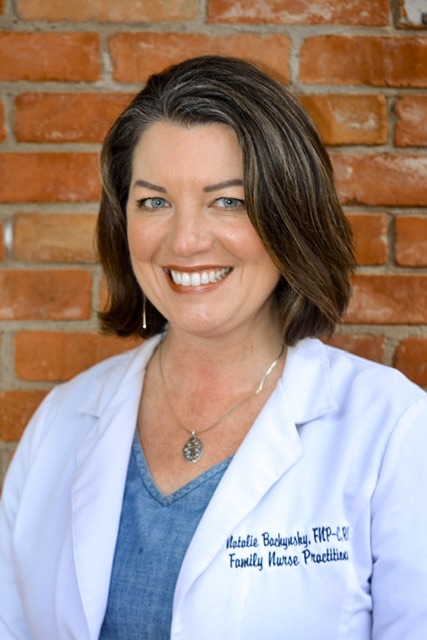
Dr. Natalie Bachynsky Appointed to State Health Committee
By Greg Ritchie
Messenger Reporter
HOUSTON COUNTY – When Dr. Natalie Bachynsky opened her medical clinic in Crockett in 2020, she was taking a calculated risk — stepping away from hospital-based care to build something more stable for her family and more dependable for patients in a county long designated as medically underserved.
That same commitment to rural healthcare has placed a Houston County provider at the center of one of the most ambitious public health efforts in Texas history.
Bachynsky, a family nurse practitioner and owner of Houston County Family Medical Clinic, has been appointed by Texas Gov. Greg Abbott to serve on the Texas Nutrition Advisory Committee, a newly created body charged with shaping statewide nutrition policy, education and preventive healthcare strategies. Her term runs through Sept. 1, 2027.
“I didn’t apply for this,” Bachynsky said. “I got a call asking if I would be willing to serve — specifically as a rural health voice. That part meant a lot to me.”
When Bachynsky launched her clinic, the operation was lean: one nurse practitioner, one medical assistant, one receptionist and her husband, Ashton, who stepped away from practicing law to help run the family business.
Patient need drove the growth. In its first year, the clinic served just over 3,000 patients. Today, that number has climbed to more than 10,000 annually, all seen within six examination rooms.
The staff has expanded to include three nurse practitioners, three licensed vocational nurses, a medical assistant, a phlebotomist, three receptionists, an administrator and an assistant administrator.
“That growth wasn’t something we planned out on paper,” Bachynsky said. “It came from patients needing care and wanting consistency.”
She said her decision to open the practice followed time working at the hospital, where she realized that building a more stable, community-centered model of care would better serve rural patients over the long term.
Bachynsky learned of her appointment through a call from Robert Haley, a Capitol staff member involved in recruiting members for the advisory committee. Her name surfaced because of her longstanding advocacy for rural health and her involvement with Texas Nurse Practitioners.
She had previously been considered for a position on the Texas Board of Nursing, a role that was ultimately not created, but her credentials and background remained on file.
“They already knew my experience and my passion for underserved communities,” she said. “So when this committee was created, my name came up.”
Texas Nurse Practitioners praised the appointment, noting it reflects the growing recognition of nurse practitioners as trusted leaders in healthcare delivery, prevention and policy development across the state.
The Texas Nutrition Advisory Committee was established under Senate Bill 25, known as Make Texas Healthy Again, passed during the 89th Legislative Session and authored by Lois W. Kolkhorst.
The legislation has drawn national attention for its comprehensive approach to improving public health, including requirements for warning labels or ingredient changes for processed foods containing certain additives, expanded nutrition education for healthcare professionals, and protections for physical education and recess in schools.
One of the bill’s four pillars is the creation of the Nutrition Advisory Committee, which will research links between ultra-processed foods, additives and chronic disease, and help develop nutrition curriculum for medical schools, nursing programs and public education — without influence from food industry insiders.
“As a nurse practitioner, about half of what I treat every day is directly related to diet,” Bachynsky said. “Diabetes, hypertension, high cholesterol — those are conditions tied to nutrition. Yet nutrition education in medical and nursing training is very limited.”
Bachynsky said one of the committee’s greatest challenges will be balancing statewide health goals with the realities of rural life, particularly in public schools.
“In rural areas, many students depend on free and reduced lunch programs,” she said. “We want healthier options, but we also have to think about preparation, volume and access. Those details matter.”
Houston County remains a medically underserved area, with shortages of physicians, nurse practitioners and physician assistants. Bachynsky said that reality shapes how she approaches both patient care and policy work.
“My perspective is grounded in what I see every day,” she said. “You can’t separate policy from people.”
In addition to her clinical work, Bachynsky is deeply involved in healthcare education and community leadership. A resident of Lovelady, she is a member of the UTMB School of Nursing Alumni Association and serves on multiple boards, including the Houston County Career Women and the Texas A&M Rural Medicine Advisory Board. She is also a member of the American Association of Nurse Practitioners.
She also serves as a medical advisor for the Michelle Lynn Holsey Foundation and volunteers as a nurse practitioner with The Murray Clinic.
Her academic background includes a Bachelor of Science in Nursing and a Master of Science in Nursing Education from the UTMB School of Nursing, a post-master’s Family Nurse Practitioner certificate, and a Doctor of Philosophy in Nursing Science from Texas Woman’s University.
Bachynsky is also working to expand healthcare access locally by helping bring medical students from Texas A&M College of Medicine to Houston County for required rural rotations beginning this year. Students will rotate through local schools, the hospital, private practices, her clinic and a new satellite clinic opening this spring in Chester.
She also precepts nurse practitioner students each semester, focusing on those interested in remaining in rural practice after graduation.
“If we want rural healthcare to survive, we have to grow it from within,” she said.
As Texas’ nutrition and health reforms continue to draw national attention, Bachynsky said she remains focused on the people who first inspired her work.
“This appointment doesn’t take me away from Crockett or Lovelady,” she said. “It gives rural communities a voice where decisions are being made.”
For her, the path from a small-town clinic to a statewide leadership role feels like a natural extension of the same mission.
“What happens in rural communities matters,” Bachynsky said. “And when those voices are included, the solutions are stronger — for everyone.”
Greg Ritchie can be reached at [email protected]