Housing Authority Remodel Raises Questions
By Greg Ritchie
Messenger Reporter
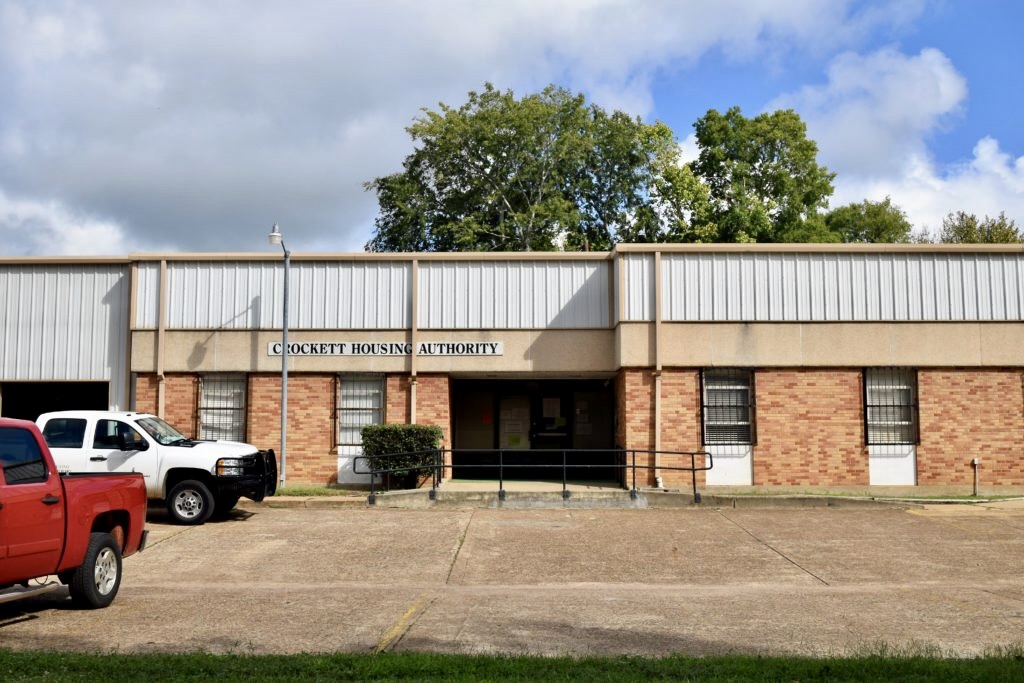
CROCKETT – The Crockett Housing Authority does not often find itself at the center of public scrutiny. A recent bid dispute has raised serious question about how entity handles bids, vendors, and even personnel matters.
The agency manages public housing in Crockett and operates in part with federal funding intended to provide stable housing to residents in need. According to its website, its mission is to “revitalize Crockett Public Housing by introducing modern appliances and amenities” and to improve housing opportunities in the community.
The Housing Authority is governed by a Board of Commissioners appointed by the Mayor of Crockett. The board sets policy and provides financial oversight. The executive director manages day-to-day operations.
That structure — who oversees whom, and who answers to whom — became important as a series of questions unfolded this week surrounding an office remodeling project that ultimately totaled more than $116,000.
What began as a review of a change order became, over the course of a single day of reporting, a much broader examination of bidding practices, permit records, company filings, and board oversight.
The remodel of the Housing Authority office was originally awarded for $79,500. Construction projects frequently involve change orders — amendments to the contract when additional work is required. In this case, a change order totaling $36,610 was later submitted.
Executive Director Courtney Yarbrough said that number is where concerns began.
After reviewing the change order line by line against the original bid, she said she determined that only $2,450 of the additional charges appeared necessary.
“When we went back through it, several of the items had either already been included in the original bid or had not been requested,” Yarbrough said.
According to her review, some of the charges in the $36,610 change order reflected work already listed in the original $79,500 scope.
Despite her objections, the full $36,610 change order was paid, bringing the total project cost to approximately $116,110.
“It was paid. I was told that I was to sign the check,” Yarbrough said.
That payment, she said, prompted her to contact the Mayor of Crockett, the city administrator, the U.S. Department of Housing and Urban Development (HUD), and the Texas Rangers.
Neither HUD nor the Texas Rangers have publicly confirmed whether a formal investigation has been opened.
Yarbrough contacted the mayor because she appoints the Housing Authority’s Board of Commissioners.
Under Texas Local Government Code §392.041, a mayor may remove a housing authority commissioner for inefficiency, neglect of duty, or misconduct in office following written charges and a hearing.
Yarbrough said she contacted the mayor because of that oversight structure.
“My concern raised when there was the $36,610 change order that wasn’t approved by me,” she said.
In other words, the issue was not only the amount — it was whether the change order had been properly reviewed and approved.
The next question was how the original $79,500 contract had been awarded. The Messenger confirmed that only one bid was received for the project.
Yarbrough said she was told that prior to her becoming executive director in January 2025, the board sought outside contractors and that the bid was advertised in Houston.
“The only thing I know, I can’t confirm factual because I didn’t see it with my own eyes,” she said. “But I was told an ad was placed in Houston and there was only vendor that came forward.”
There is no rule prohibiting a public entity from awarding a contract when only one bid is received. However, public procurement processes are generally structured to encourage competition and transparency.
In a small rural community where public entities often seek competitive bids and frequently rely on local contractors, the fact that a single Houston-based company was the sole bidder stood out.
The company identified in project documents was Texas Remolding LLC — spelled without the second “e” in “remodeling.” A search of Texas Secretary of State records shows an entity registered as “Texas Remolding LLC,” formed in April 2022.
State filings list Farrukh Khan as the registered agent, with a residential address in Houston.
While the Secretary of State listing shows the entity as active, Texas Comptroller records list the company’s right to transact business in Texas as “forfeited” for failure to file required reports or make required payments.
In Texas, forfeiture of the right to transact business typically occurs when a company fails to file franchise tax reports or pay required franchise taxes. The entity remains on record with the Secretary of State but is not considered in good standing with the Comptroller until reinstated.
Beyond state filings, the company’s public footprint appeared limited. No company website could be located. The contact email listed on project documentation was a Gmail account rather than a company domain.
Small contractors often operate without formal websites. However, the combination of a residential registered address, forfeited tax status, absence of a business website, and a six-figure public project located roughly 150 miles from Houston raised additional questions about vetting and oversight.
None of those facts alone establish wrongdoing. But taken together, they added another layer to the inquiry.
As the investigation continued, The Messenger submitted a public information request to the City of Crockett seeking records of any construction or remodeling permits associated with the Housing Authority project.
City Administrator Lee Standley responded in writing:
“In response to your request, the City of Crockett has no record of construction or remodeling permits having been filed or approved for the Crockett Housing Authority under the names Farrukh Khan or Texas Remodeling, LLC.”
Standley confirmed he verified the information with the City’s Building Official and added that projects of this type would typically require a permit.
As of press time, it was not known whether permits may have been obtained under another name or whether subcontractors obtained permits. The absence of permit records under the contractor’s name added yet another question to the growing list.
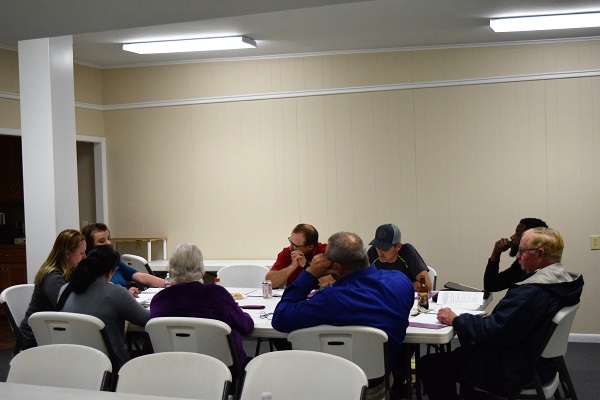
The Housing Authority board held a regularly scheduled meeting on Tuesday, Feb. 17. The agenda did not list the remodel as a discussion item, and the contractor, Farrukh Khan, was not listed as a presenter.
He addressed the board during the public comment portion of the meeting. Yarbrough said she did not expect him to attend.
During his remarks, Khan defended the project.
“There was a lot of work being done,” he said. “She [Yarbrough] approved the change order.”
He said the office was reopened within 10 days and that additional work became necessary as the project progressed.
Yarbrough disputes she approved the change order, expressing her concerns in a board meeting. She claims shortly after the board meeting, one board member told her she had to sign the check for the change order, in spite of her concerns..
When contacted by The Messenger, Khan said he would return a call for further comment but had not done so prior to publication.
Yarbrough said tensions escalated after she declined to approve most of the change order.
“When I told the vendor I couldn’t approve it, I was put in a board meeting with a supposedly yearly evaluation,” she said.
She said she was later informed she had been placed on a 90-day probation.
“That was definitely made up on the spot,” she said. “It’s not in my contract.”
Yarbrough signed a three-year employment contract in January 2025.
The Messenger learned the board plans to call a special meeting to address “personnel matters” next week.
Board Chair Lois Ball did not return calls seeking comment prior to publication.
Yarbrough said she fears retaliation, in spite of her contract, as she sheds a light on this situation.
As the investigation continues, the unusual situation raises a number of questions:
Why was only one bid received for a $79,500 public project?
Where and how was the project advertised?
Were local contractors notified or invited to bid?
Under what exact legal name was the contract executed?
Under what name were payments issued?
Was a W-9 submitted, and if so, under what classification?
Were required construction permits obtained under another name?
If permits were not obtained, why?
Have any state or federal authorities formally initiated investigative action?
The Messenger will update our readers on this ongoing story.
Greg Ritchie can be reached at [email protected]