Dispute Puts Hurricane Bayou Bridge Project at Risk
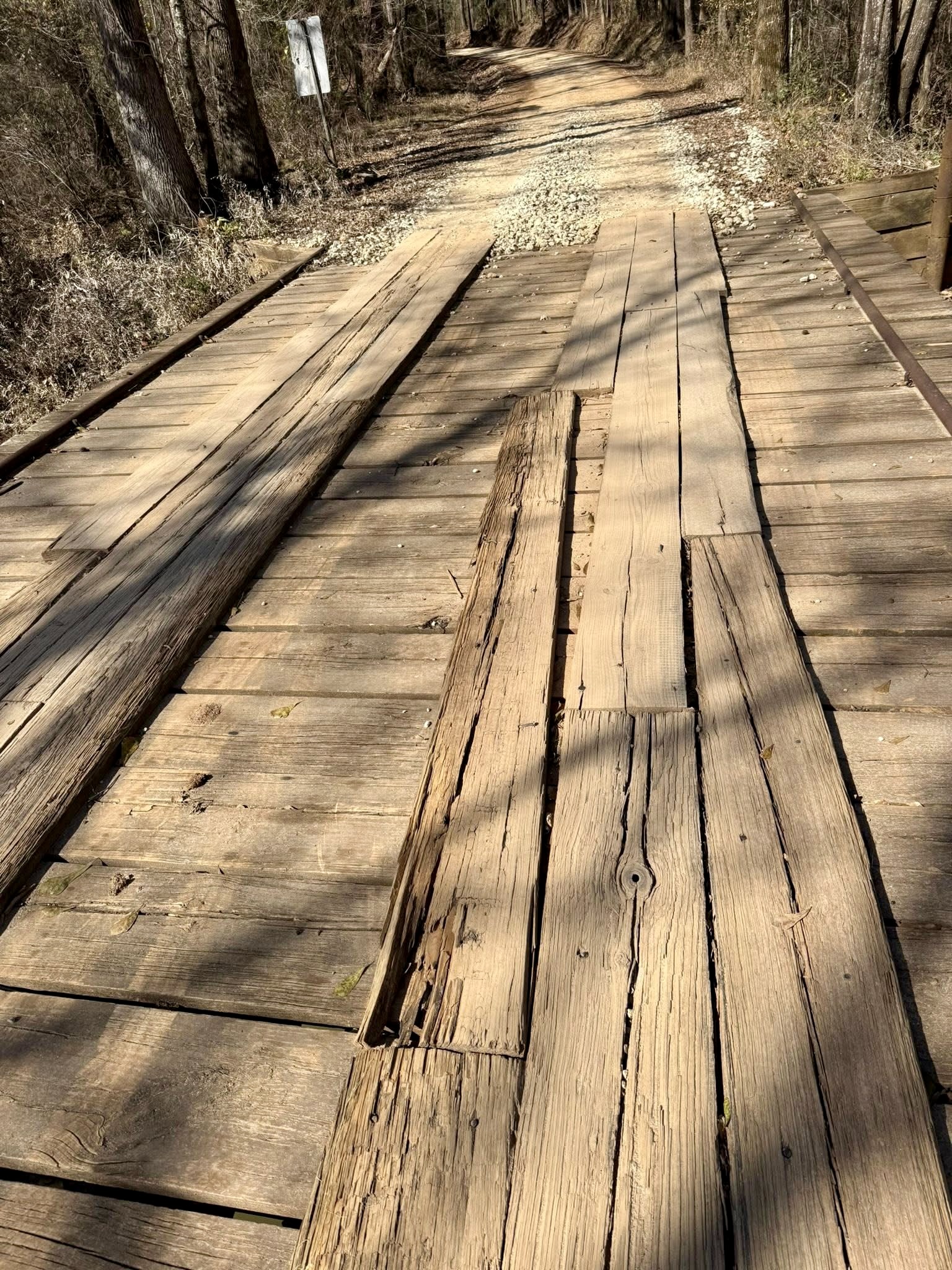
***Photos courtesy of Richard Harrison
By Greg Ritchie
Messenger Reporter
HOUSTON COUNTY – A state-funded project to replace two aging bridges in Houston County could be delayed or abandoned entirely as unresolved easement issues push county officials toward eminent domain proceedings.
The bridges, located on County Road 2065 over Hurricane Bayou and a nearby tributary, serve residents in the Halls Bluff and Wheeler Springs areas and provide a connection between FM 2076 and FM 229. County officials say the structures have been flagged during routine inspections and qualify for replacement under a state and federally funded off-system bridge program.
Precinct Two Commissioner Willie Kitchen said the bridges are inspected by the state every two years and have been deemed eligible for the program, which covers the vast majority of construction costs. Under the arrangement, Houston County is responsible for roughly 10 percent of the project cost, a portion that can be met through in-kind work such as drainage improvements rather than direct taxpayer expense.
“These bridges are going to cost more than $1 million,” Kitchen said. “There’s no way a single precinct could afford that without the state program.”
County officials say negotiations to secure temporary construction easements have stretched on for nearly two years, an unusually long timeframe for projects of this type. Without those easements, the Texas Department of Transportation (TxDOT) cannot put the project out for bid or establish a construction schedule.
Assistant County Attorney Hugh Coleman said acquiring right-of-way typically occurs much earlier in the process and rarely drags on for that length of time.
“In my experience, acquiring right-of-way for two years is extremely atypical,” Coleman said.
TxDOT spokesman Tim Monzingo confirmed the project is considered an off-system bridge replacement, meaning the roadway itself is maintained by the county, but the state partners with local governments to improve infrastructure that would otherwise be costly for counties to address on their own.
“We work with counties throughout the district and across the state on off-system bridges,” Monzingo said. “It’s a routine part of what we do to help maintain safe and reliable infrastructure for the traveling public.”
Monzingo said TxDOT cannot move forward with bidding or construction until access issues are resolved.
“Until those issues are worked out, we can’t set a timeline or put the project up for bid,” he said.
County officials warn the project faces a firm deadline. If the required easements are not secured by June, the state could withdraw funding and redirect it elsewhere.
“If the project is not shovel-ready by that point, the state can walk away,” Coleman said. “At that point, residents would lose that access and the county would be left to find another solution.”
Kitchen said losing the project would likely force the county to close the bridges entirely, turning what is now a through road into a dead end on both sides of Hurricane Bayou. Some residents would face detours of seven miles or more, and emergency response times would increase.
Several residents who live and work in the area say the bridge is already prone to flooding and closure during heavy rains.
Steven Marietta, who uses the bridge regularly, said access becomes especially difficult when Hurricane Bayou floods.
“If the water gets up, I can’t get out unless I go the long way,” Marietta said. “That’s 20 to 30 minutes just to get into Crockett.”
Marietta said he has been told the replacement bridge would be built several feet higher, reducing flooding issues. He also noted that if state and federal funding is lost, the financial burden would ultimately shift to local taxpayers.

“That cost gets spread out right now across a much larger group of taxpayers,” he said. “If the state and federal government pull out, then it all falls on Houston County. And that bridge is going to have to be replaced eventually anyway.”
Jimmy Gardner, who owns land in the area used for agricultural operations, said the bridge is critical for daily access.
“It goes underwater pretty often,” Gardner said. “If they fix it, it would mean better access and probably increase property values. If it’s condemned and shut down, that’s not really an option for the people who use that road.”
Gardner said detours could add more than 10 miles to routine trips and complicate farming and ranching operations.
Several other residents expressed similar concerns about access, emergency response times and increased travel distances, though they asked that their names not be published.
In December, Houston County Commissioners Court approved resolutions authorizing the acquisition of necessary easements and, if needed, condemnation proceedings to keep the project moving forward. As part of that process, the county hired a firm to conduct legally required appraisals on three properties at a total estimated cost of $16,500, according to county records.
Coleman said those steps are required under state law before eminent domain proceedings can advance.
“The county has been extremely patient,” he said. “But at this point, we’re at risk of missing the deadline altogether.”
County officials emphasized that the easements involved are limited in scope and tied only to construction access, not permanent land acquisition.
“We’re talking about temporary construction easements,” Kitchen said. “Once the project is finished, fences are rebuilt and the land is returned, often in better condition.”
Attempts to reach the affected property owner for comment were unsuccessful as of press time.
For now, county leaders say they are moving forward with the legal process in hopes of preserving the project and avoiding closure of the bridges.
“Our goal is to keep access open and get these bridges replaced before they become a bigger problem,” Kitchen said.
Greg Ritchie can be reached at [email protected]