Commissioners Meet to Discuss County Groundwater District

By Greg Ritchie
Messenger Reporter
HOUSTON COUNTY – Houston County commissioners will take up one of the county’s most pressing long-term issues Thursday afternoon: whether to move ahead with creating a local groundwater conservation district before outside interests tap into the county’s aquifer.
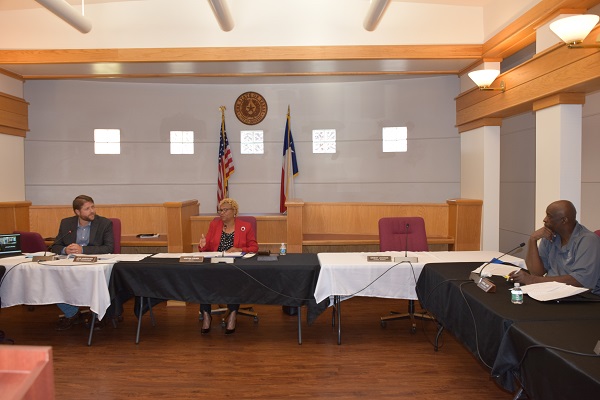
A special meeting of Commissioners Court is set for 1:30 p.m. Thursday, Nov. 20, at the courthouse at 401 E. Goliad in Crockett. The agenda calls for a workshop “to discuss a possible petition to the Texas Commission on Environmental Quality for creation of a groundwater conservation district for Houston County,” along with an advisory update from the citizen groundwater steering committee and time for public comment.
The discussion comes as a sprawling legal battle continues just across the county line over a proposal to pump and export up to 16 billion gallons of groundwater from the Carrizo-Wilcox Aquifer.
Earlier this year, the Neches & Trinity Groundwater Conservation District (NTVGCD) agreed to pause all new high-capacity well permits while experts study the aquifer. That pause followed a lawsuit by Wayne Sanderson Farms, Consolidated Water of Houston County and others against Dallas-based Conservation Equity Management and the district itself.
Developers tied to billionaire investor Kyle Bass had sought permits for roughly 40 high-volume wells northeast of Houston County. Plaintiffs warned the project could devastate rural water systems and private wells across the region.
Consolidated Water board president Kim Spellman likened the proposed pumping to draining “about 16,000 Crockett football stadiums” worth of water.
“That immediate threat is on pause for further testing,” Spellman said at the time. “But they could move their drilling just a few feet across the county line. The aquifer doesn’t recognize county borders, and that’s the scary part.”
Since then, Bass has filed his own lawsuit seeking to restart the project and overturn decisions that slowed it down, according to court filings.
The original suit also accused NTVGCD of being compromised by conflicts of interest, pointing to former board member Don Foster, whose Athens-based drilling company was later chosen for the multimillion-dollar project. Testimony in Austin hearings indicated Foster met with Houston County Electric Co-Op officials in early 2023 as an “agent” for Redtown Ranch, LLC, one of Bass’s companies, months before he filed any conflict-of-interest paperwork. Foster has since resigned; the district has denied that his departure was tied to the well permits.
State Rep. Trent Ashby has called the pause “a step in the right direction” but warned that “the fight to protect our aquifers is far from over,” pledging to keep working on stronger groundwater protections so “communities — not outside interests — determine the future of our water resources.”
Those regional fights are driving renewed interest in local control inside Houston County itself.
As previously reported in The Messenger, a five-member steering committee has been meeting for months to study whether Houston County should form its own groundwater district.
Geologist and committee member Barrett Riess has said that without a district, Houston County is “one of the few counties sitting over the Carrizo-Wilcox with no real way to manage what happens underground.”
“It’s kind of like a giant holding tank beneath us,” Riess said. “Once the bowl’s empty, it’s empty. It takes an incredibly long time to refill. With a huge water source under us, it will be exploited by others if we don’t have some checks and balances.”
Riess and other supporters note that domestic and livestock wells would not be regulated under the type of district they envision; instead, the focus would be on the kind of high-capacity wells at the center of the current lawsuits.
“There’s this fear that we’d be putting meters on everyone’s wells or charging them for water,” Riess said. “That’s not going to happen. What we’re talking about regulating are the massive wells — those pumping tens of thousands of gallons a day. The average family or rancher is not going to feel this.”
Consolidated Water general manager Amber Stelly, who serves as vice chair of the steering committee, has also been a visible voice in the debate. She and other local water leaders argue that while the pause in Anderson County is welcome, it underscores how exposed Houston County remains without its own district.
Spellman called the situation “bittersweet.”
“We fought hard to slow this down, but without our own district, that same fight might just be moving closer to home,” she said.
Thursday’s workshop is expected to cover what a petition to the Texas Commission on Environmental Quality would look like, possible timelines, and how a new district might be structured. Any eventual district would still have to be approved by Houston County voters.
The meeting is open to the public, and commissioners have set aside time for citizen comments.
Greg Ritchie can be reached at [email protected]