Houston County Fights to Save Water

Greg Ritchie
Messenger Reporter
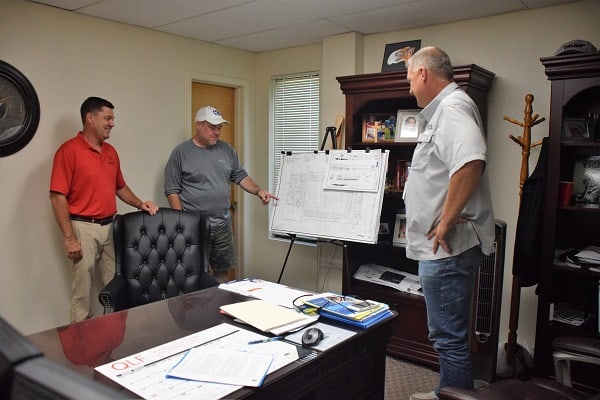
HOUSTON COUNTY – A special meeting of Houston County commissioners court was held Thursday, June 5 to discuss the potential loss of billions of dollars of groundwater to a corporation looking to sell the water to larger cities. The meeting was held in the County Annex to accommodate members of the public who wished to speak or get an update on the situation.
Houston County Judge Jim Lovell, visibly upset about the situation, opened the meeting by inviting members of the public to share their comments and to send in the protest form, of which county officials had made dozens of copies for residents to fill out.
Lovell pointed out residents were not alone in fighting for the area’s groundwater, joined by people in surrounding counties and representatives from around the state.
“We’re adamantly opposed to this project, and so are all of our legislators in the state that represent us,” Lovell said. “The Carrizo Wilcox aquifer is something that is a great source of groundwater for the future of Houston, Anderson Counties, and East Texas, and we don’t want it depleted.”
Consolidated Water’s Amber Stelly told commissioners the size of the project and warned there were other questions still yet to be answered by Redtown Holdings and its sister companies in their application.
“15.5 billion gallons annually, for the purpose of this permit application — these numbers are staggering. The numbers exceed the modeled available groundwater, according to the management plan for this district. I think everyone has to be concerned about these numbers. Many people are calling and asking me, what is the use? What is this for? We don’t know. I can only tell you what the application states, the application says, ‘for all beneficial purposes.’ It’s just some sort of benefit,” Stelly explained. “With that being said, the applicant references all beneficial uses. Maybe we need to ask them. However, the application process does require specific use, its volume by type, So, that’s something that is lacking in this application.”
Stelly said Consolidated Water does consider itself to be an “affected party” and plans to challenge the project officially.
“Given the risk to our members and our neighbors. Consolidated Water has decided, of course, to officially contest the ratification process. This is a formal legal proceeding. Anyone who is concerned or think they are an affected party, should be doing the same. Those instructions are being distributed. We are also establishing a page on our website to help people, many who have so many questions, to make sure everyone has a place to go to get more information.”
Lovell was more direct in his comments, pointing out the facts of the case, sometimes unsaid, but seemingly understood by everyone involved.
“Amber did not state the use of this water, because she’s not sure and she said that. It’s to export water. And it’s to export water to the city of Dallas. I’m sure of that. I don’t factually know that, but they’re not producing that much water to water cattle down there or to fill up ponds. The electric co-op has run a three-phase line that cost that ranch a million dollars. They don’t need that kind of electricity to light their barn. This was a plan from the time they bought the ranch,” Lovell said.
The commissioners voted to allow Lovell to engage the services of Allen, Bass and Magee, LLP to officially contest the well project with Neches and Trinity Valleys Groundwater Conservation District. Precinct Two Commissioner Willie Kitchen offered to see out other legal offices who may have more experience with water issues, too.
Precinct Three Commissioner Gene Stokes spoke for many when he pointed out the crucial question of the project. Laying technicalities aside, who would benefit from these wells? No one in Houston County, Stokes said.
“These people want to capture this water, sell it, and for places like Dallas and Fort Worth to profit at our expense. These wells will not be a service to anyone in this county. They are for one reason and that’s profit. A lot of wells have been drilled in this county — private and commercial. But those wells were drilled to benefit activities going on right here in this county,” Stokes concluded.
Greg Ritchie can be reached at [email protected]